Axiom OS
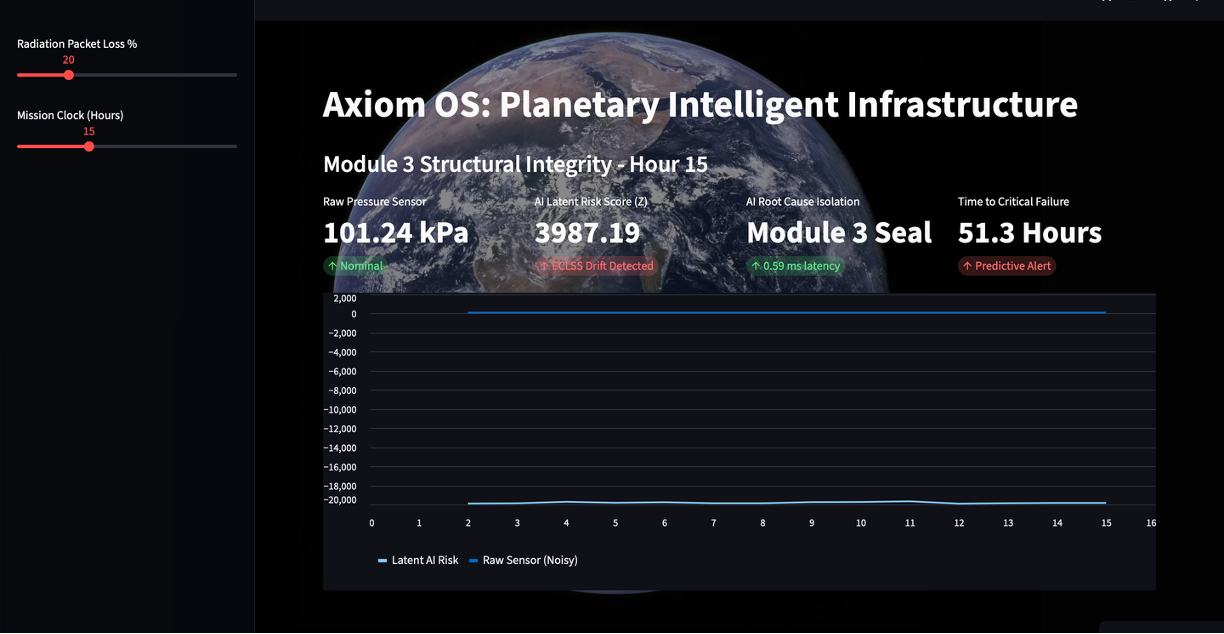
Axiom OS is a high-performance Neural Digital Twin platform for off-world life-support systems (ECLSS) and planetary habitat autonomy. It processes multi-dimensional environmental telemetry directly at the edge, utilizing deep latent space inference to predict structural degradation and systemic risks before critical failures occur, entirely mitigating the fatal 44-minute Earth-Mars communication latency to safeguard crew lives in deep space.
Key Features
- Latent Space Inference Engine: Implemented a PyTorch-based neural digital twin architecture that maps high-dimensional, noisy environmental telemetry into low-dimensional latent vectors (z-states) to flag multi-system anomalies long before raw threshold breaches occur.
- Predictive Degradation Vectoring: Engineered a real-time structural health monitoring module that continuously calculates pressure drop velocities and telemetry drift rates to dynamically project Time to Critical Failure (ETCF) metrics under extreme operational stress.
- Edge-Native Root Cause Isolation: Developed a localized anomaly isolation pipeline capable of instantly identifying hardware faults (e.g., life-support module seal failures) directly on the edge asset, reducing diagnosis latency to under 1 millisecond.
- Radiation-Resilient Data Pipelines: Modeled a high-fidelity telemetry generator capable of simulating up to 90% synthetic radiation-induced packet loss to stress-test and validate model convergence under severe deep-space communication constraints.
- Environment-Agnostic Infrastructure OS: Architected a modular Python-backed deployment framework utilizing clean decoupled path logic to seamlessly bridge physics-based simulation engines with live deep-learning runtime dashboards.
Strategic Mission Capabilities
- Martian City Base-OS (SpaceX Integration): Engineered to replace heavy, over-engineered hardware redundancies with an elegant, edge-native software solution. Acts as the autonomous "Full Self-Driving" equivalent for off-world Starship habitats, allowing early Mars settlements to scale securely. By utilizing an AI digital twin to infer system health from minimal existing hardware, it ensures localized life-support anomalies are resolved without relying on manual, high-latency diagnoses from Earth.
- Artemis Base Camp Risk Mitigation (NASA Integration): Designed to directly address critical crew-abort risk profiles associated with deep-space communication blackouts and solar particle events. Serves as an autonomous ECLSS safety layer for the Lunar Gateway and surface habitats, maintaining uninterrupted structural integrity monitoring, even when deep-space network packet loss hits 90%, ensuring total crew autonomy and safety when Earth goes silent.